Supporting Your Neurodivergent Athlete at Home: Building Confidence and Success
My son never enjoyed school. After the Davis® program, academics became easier and his self-confidence improved—but he couldn’t help comparing himself to his older brother, who naturally loved books, reading, and learning.
Then he found sports.
Everything changed. He loved it. I truly believe his confidence and resilience today stem directly from this athletic foundation, though being a dyslexic athlete came with bumps. He was physically gifted—he dominated on a pure athletic level—but the vocabulary, the plays, the coaching language? Sometimes that confused him. And when he hit middle school and experienced coaching transitions, new coaches brought different teaching methods and terminology he had to decode all over again.
That’s when I realized: what happens at home matters just as much as what happens on the field.
The hours between practices and games—how you prepare your child, how you respond to setbacks, how you reinforce learning, and how you interact with your child during and after the game—can be the difference between a child who thrives in sports and one who gives up.
This isn’t about becoming an assistant coach or turning your backyard into a training facility. It’s about creating a home environment that builds on what’s happening at practice, can rebuild confidence when it wavers, and helps your child develop the resilience that will serve them far beyond sports.
Let’s talk about how to do that and where to start.
Self-Regulation Tools
Before your child walks into practice or steps onto the field, they need to be ready—mentally and physically, that’s where self-regulation tools come in. These are simple techniques you can teach your athlete to get their brain and nervous system into the optimal space for learning and performing.
If you’ve already completed a Davis® Program, you have an excellent focusing tool for academics and learning—keep using that as is. For sports, however, you might want to introduce a sports-specific focus point that works better for athletic performance. For many field sports athletes find a focus point located directly above the forehead works great, as it gives them a wider view of the playing area and helps with quicker reaction times.
If you haven’t completed a Davis® program and don’t have the Davis self-regulation tools, don’t worry. Here are three essential self-regulation tools every neurodivergent athlete needs:
A Focusing Tool: The String Method
A sports focus can often be located directly above the head—about six-inches to a foot above, between the crown and their forehead. Here’s a technique you can teach your child to find and maintain that focus point:
Step One: Find Your Balance
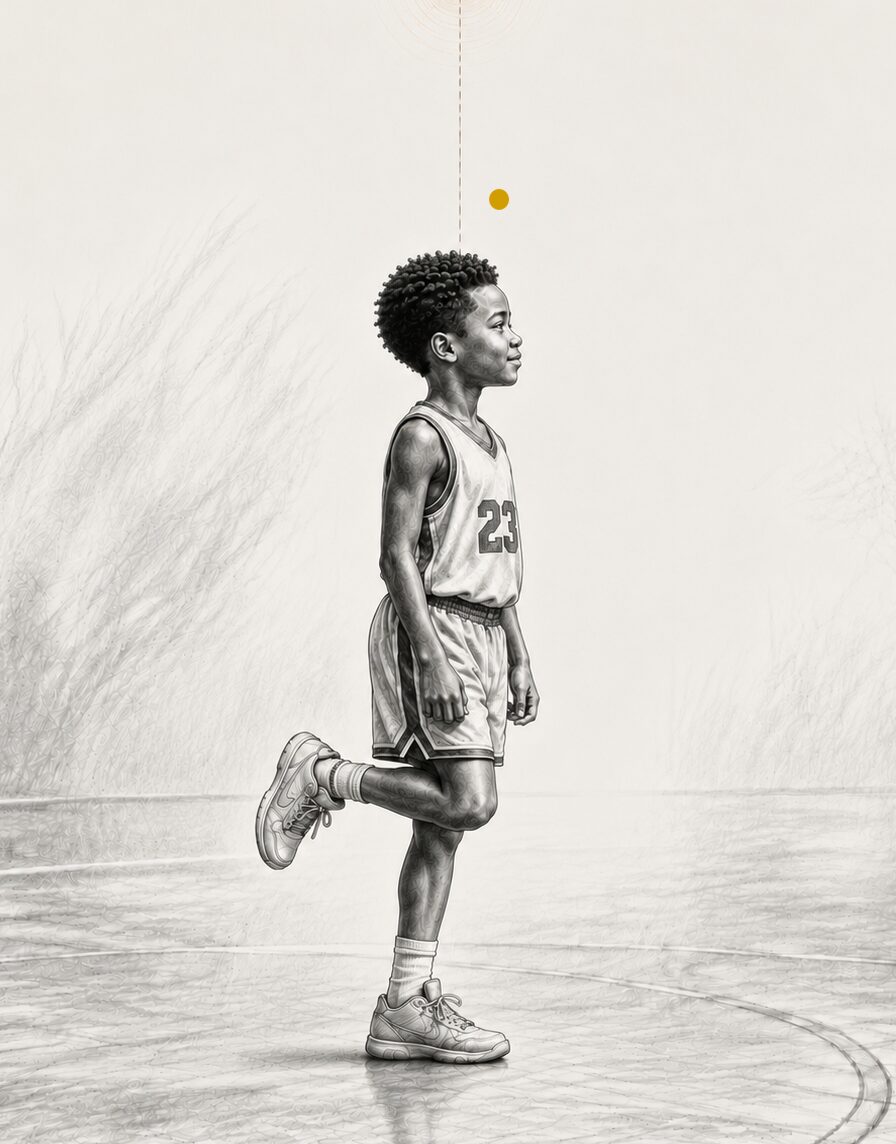
Have your child stand up straight and shift their weight onto one foot. They’re going to balance on one leg—it doesn’t matter which one. The act of balancing requires their brain to orient itself. You literally cannot balance while disoriented. This simple physical act is the foundation.
Step Two: Imagine the Strings
While balancing, have them visualize that there is a string holding them up. Picture a string attached to the crown of their head, gently pulling them upward. This invisible string is holding them in perfect alignment. This visualization gives their brain a clear, physical reference point—something concrete to focus on rather than an abstract idea.
Step Three: Place Your Focus Point
Now have them imagine a dot floating about six-inches to a foot above their head, and just forward of the string maybe in inch to two forward. This dot is their focus point. It’s not moving. It’s not complicated. It’s just there, steady and clear.
Step Four: Return to Your Dot
Whenever they need to refocus in practice or a game have them think of that dot. Imagine the feeling of the string holding them upright and aligned as they see the dot in their mind. If they have a moment, actually balance on one foot. If they don’t have time for that, just mentally picture the dot and feel the strings holding them upright.
Your child will need to experiment with this focus point as they play their sport. If it doesn’t feel quite right or they can’t get into the zone, they may need to shift it slightly.
For example, a baseball player might try it while catching and again while stepping up to bat. The softball and baseball athletes I’ve worked with all really liked this focus point. One soccer player told me he felt much quicker reacting with it, and a hockey player said he could see the court better. If your child swims or does martial arts, this particular focus point might not be the best fit—but the principle still holds: finding a focus where their body feels grounded and in alignment will serve them well.
Once they find the right spot, it becomes a quick mental reset they can use anytime—before stepping up to bat, before a free throw, before taking the field. It is important to practice using this new focal point. After using it intentionally overtime it will become second nature.
A Calming Tool: Nervous System Reset
When your child is feeling anxious or overwhelmed—waiting to bat with everyone watching, or after a frustrating play, they need a way to calm their nerves. Teach them a simple breathing technique: slow, deep breaths in through the nose, and longer exhales out through the mouth. This signals to their body and mind that they are safe and helps release the anxiety that builds in high-pressure moments.
An Energy Tool: The Dial or Lever
In Davis® work, we call the energy tool “your dial.” If your child hasn’t learned this yet, think of it as an energy lever they can actively control and adjust based on the activity. The energy needed to listen to instructions is very different from the energy needed to sprint down a football field or explode off the line. Teach your child to consciously adjust their internal lever before each activity—turning it lower for focus and listening, higher for explosive movement and intensity. They’re in control of dialing in exactly what they need.
These three tools—focus, calm, and energy—work together to prepare your athlete’s brain and body for success.
Pre-Teaching Vocabulary and Concepts
When starting a new sport or going back to a sport for a new season, vocabulary can change, when this happens, it can be very helpful to pre-teach vocabulary and concepts at home to help reduce the cognitive load your child faces at practice.
When your child walks into practice and hears unfamiliar terminology or new concepts for the first time, they’re trying to do three things simultaneously:
- Decode and understand the words
- Grasp the concept being explained
- Figure out how to execute it physically
That’s a lot. For a dyslexic that often processes language more slowly, it’s can be too much and they have disoriented or fall behind and miss information. For a kid with ADHD, following the sequencing and timing of a new play can cause some disorientation, resulting in missing understanding.
When you pre-teach vocabulary and concepts at home, your child arrives at practice already familiar with the language and basic ideas. Now they can focus their cognitive energy on execution and refinement rather than basic comprehension.
Ways to Pre-Teach Effectively
Get the practice schedule or curriculum in advance
Ask the coach: “What will you be working on this week?” or “What plays or skills are coming up?” Most coaches are happy to share this information, especially when you explain it helps your child prepare.
Introduce terminology in a low-pressure setting
A few days before practice, casually introduce the terms:
“Hey, I heard Coach is going to work on ‘pick and roll’ this week. Want to see what that looks like?”
Then show them a short video clip (YouTube is full of examples) or demonstrate with household objects.
Use visual aids and or physical demonstration
Don’t just define the term verbally. Show it:
- Watch professional athletes execute the skill
- Watch a YouTube lesson on it.
- Walk through the movements
- Have fun:
- model it in clay
- Draw a simple diagram or
- Use action figures or toys to demonstrate a play
Make it interactive and playful
“Okay, you be the defender, I’ll be the offensive player. I’m going to show you what a ‘give and go’ looks like.”
Learning through play removes pressure and makes the concept stick.
Keep it brief
Five to ten minutes is plenty. You’re not teaching them to master the skill—just familiarizing them with the concept and language so it’s not brand new when the coach introduces it.
Real-World Example
Your child’s soccer coach is introducing “overlapping runs” next practice.
A few days before practice:
- You watch a 2-minute YouTube video together showing overlapping runs in professional soccer
- You walk through it in the backyard: “You dribble here, I run past you here, you pass to me here”
- Have them teach it back to you.
At practice:
When the coach says “We’re working on overlapping runs today,” your child thinks, “Oh yeah, I know what that is!” Instead of disorienting, they experience recognition and confidence.
The Confidence Multiplier
Pre-teaching doesn’t just reduce confusion—it creates a powerful psychological advantage.
Your child walks into practice feeling prepared and competent. When the coach introduces the concept, they might be one of the first to understand it. They might even demonstrate it successfully on the first try.
Suddenly, they’re not the kid who’s a step behind. They’re the kid who is a step ahead.
That feeling is transformative.
Ongoing Support
Learning-Focused Conversations After Practice
Instead of “How was practice?”—which usually gets a one-word answer—try asking questions that help your child process what they actually learned:
- “What did Coach teach you today?”
- “Did you learn anything new?”
- “What was the most interesting part of practice?”
These questions shift the focus from performance to learning. They give you real insight into what stuck, what confused them, and what might need reinforcement at home. Plus, they help your child recognize their own growth instead of just worrying about whether they did it “right.”
Build a Highlight Reel
Keep a running collection of your child’s best moments—video clips, photos, or even just a written list of wins big and small. You’ll miss recording plenty of moments (especially during practices) and that’s okay. What matters is having something to pull out when you need it.
Use this highlight reel strategically:
- Before big games to remind them of what they’re capable of
- When confidence dips after a tough practice or loss
- Just to celebrate progress and growth
Here’s what surprised me: my son and I would work on his highlight reel at different times during the season, but when his brother made one set to his favorite music and showed it to him, my son noticed something we’d both missed. His brother (who understands sports more then I do) had picked out different moments than we had. His video showed the screens, the pick-and-rolls, and the passes that led to assists. Not just the flashy moments or the baskets. My son felt a surge of pride realizing his brother could see how hard he was working, not just the highlight-reel plays. That’s the power of this tool: it shows your child what others see in them.
Difficult Experiences
Even with the best coach and excellent preparation, your child will have hard days. They’ll make mistakes. They’ll feel frustrated. They might have a game where nothing goes right or a practice where they feel like they can’t do anything correctly.
How you respond in these moments can really help your athlete build resilience.
What Not to Do
In these moments, avoid minimizing their feelings, jumping straight to solutions, or comparing them to others. All of these responses—whether it’s “It wasn’t that bad,” “Here’s what you should do differently,” “But you did better than your teammate,” or “I’m so proud of you!”—dismiss their experience and create distance.
What to Do Instead
Validate their feelings first:
“That was a really frustrating practice, wasn’t it?” or “I can see you’re disappointed with how that game went.”
Let them know their feelings make sense. Sit with the disappointment for a moment before trying to move past it.
Ask what they’re thinking:
“What was the hardest part for you?” or “What are you feeling most frustrated about?”
Sometimes they just need to be heard. Other times, this helps you understand what specifically went wrong so they can address it. This can help move from frustration to empowerment.
Help them identify one thing that went well:
After they have shared their experience, you can help them identity something that went well such as “I noticed you made a great pass in the second half” or “Your footwork on that one play was really solid.”
This isn’t sugar coating—it’s helping them see that a bad game doesn’t mean everything was bad. It builds the habit of balanced self-assessment.
Reframe mistakes as information:
“So you’re saying the timing was off on that play. That’s really good to notice. Now you know what to focus on in practice.”
Mistakes become data points for improvement rather than evidence of failure.
Remind them of past progress:
“Remember when you first started and [specific skill] felt impossible? Now you do it without even thinking. This new thing will get easier too.”
This builds confidence that struggle is temporary and improvement is possible.
Ask what they could do to make a change:
Here’s where you help them figure out what actually went wrong—and what they can control next time.
Start with: “What do you think you could do differently next time?”
Listen to their answer. They might say “I need to practice that move more” or “I didn’t understand what the coach was asking” or “I felt confused out there.” All of these are valuable.
If it’s a skill gap (they recognize they need more practice):
“That makes sense. That’s exactly what practice is for—building that skill. What part do you want to focus on first?”
This frames practice as the solution and puts them in control of what to work on. You can offer to practice together in the backyard, or ask if they want to watch a video of that play first.
If it’s a self-regulation gap (they felt confused, disoriented, or anxious):
Ask: “Did you feel clear about what you were supposed to be doing, or were there moments where things felt confusing?”
If they recognize the confusion or anxiety, you’ve found the real issue. Then: “Remember those focusing and energy tools we’ve been practicing? That’s exactly what would help you feel more grounded and clear next time. Want to practice that before your next game?”
If they didn’t notice the disorientation, you can gently point it out: “I noticed you seemed a little lost out there. Sometimes when we’re not feeling grounded, it’s hard to focus on what the coach is saying. That’s where your focus tool comes in.”
The key: help them recognize what went wrong so they’re motivated to use their tools next time. They’re not being told what to fix—they’re discovering it themselves.
Offer physical comfort and connection:
Sometimes a hug, sitting together quietly, or going for ice cream says more than words. Physical presence communicates “I’m here with you in this” without requiring them to talk about it.
The Long-Term Vision: Sports as a Resilience Builder
Here’s what you need to remember on the hard days, when you’re wondering if all this effort is worth it:
Sports aren’t just about athletics. They’re about building the whole person.
For your dyslexic child, sports can be the place where they discover something school might never show them: They are capable, competent, and strong.
Sports Build Identity Beyond Academics
In school, your child may be “the one who struggles with reading” or “the kid who needs extra help.”
In sports, they can be “the player with great field vision” or “the teammate who never gives up” or “the athlete with creative moves.”
This alternative identity reminds them—and everyone else—that they are more than their academic challenges.
Sports Teach Resilience Through Lived Experience
You can tell your child a thousand times that struggle leads to growth. But it’s different when they live it—when they practice a skill over and over until they finally nail it, when they lose a game and come back to play stronger, when they make a mistake and figure out how to recover.
That’s when it clicks. Not as an idea, but as something they’ve actually done. And that lived experience of pushing through and improving? It carries into everything else in their life.
Sports Provide Concrete Evidence of Progress
In school, your dyslexic child works hard—but progress often feels invisible. They study, they try, they put in effort, yet the results can feel abstract and slow to appear.
Athletic progress is different. It’s physical and visible. Your child can see and feel themselves getting better in real time:
- “I couldn’t dribble with my left hand at the start of the season, and now I can”
- “I used to be afraid of the ball, and now I’m not”
- “I didn’t understand that play, and now I can execute it”
This visible, concrete evidence of improvement—where effort directly translates to measurable progress they can witness themselves—builds self-efficacy: the belief that focused effort actually leads to improvement.
Sports Create Community and Belonging
Being part of a team gives your child a place where they belong, where they contribute, where they matter.
For children who may feel isolated or different in academic settings, this sense of belonging can be profound.
Sports Teach That Different Strengths Matter
Your child learns that there are many ways to be valuable:
- Speed matters, but so does strategy
- Scoring matters, but so does defense
- Individual skill matters, but so does teamwork
In the real world, people need all kinds of strengths. Speed and strategy. Scorers and defenders. Solo players and team players. School often only values one narrow set of skills. Sports shows your kid that the world is much bigger than that.
The Skills Transfer Beyond the Field
The skills your child develops in sports—resilience, teamwork, communication, handling pressure, recovering from mistakes, working toward long-term goals—are exactly the skills they’ll need in careers, relationships, and life.
You’re not just raising an athlete. You’re raising an adult who knows how to persist through difficulty, who can collaborate with others, who understands that failure is temporary and improvement is possible.
Your Role in the Long-Term Vision
Your job isn’t to make your child a star athlete or to ensure they never struggle.
Your job is to:
- Help them find environments where they can succeed
- Teach them to advocate for what they need
- Support them through setbacks
- Celebrate their growth
- Remind them of their strengths when they forget
- Keep the long-term vision in focus when the short-term is hard
You’re teaching them that they can navigate and thrive in a world that isn’t always built for how their brain works.
The Ripple Effect
When neurodivergent children find success in sports:
Their confidence grows and spills into other areas. They start advocating for themselves in school. They try new things. They take risks. They believe in their ability to figure things out.
The resilience they build on the field shows up in other places of life. The problem-solving skills they develop in games help them find creative solutions to academic challenges. The identity they build as a capable athlete balances the identity of “struggling student.”
Sports become the foundation that supports everything else.
Your neurodivergent child can find joy, confidence, and belonging in sports. They can build resilience that transforms their entire life.
And you—through your advocacy, your support, and your unwavering belief in their potential—are making that possible.
You’ve got this. Your child has got this. And together, you’re building something that will last far beyond any season.